
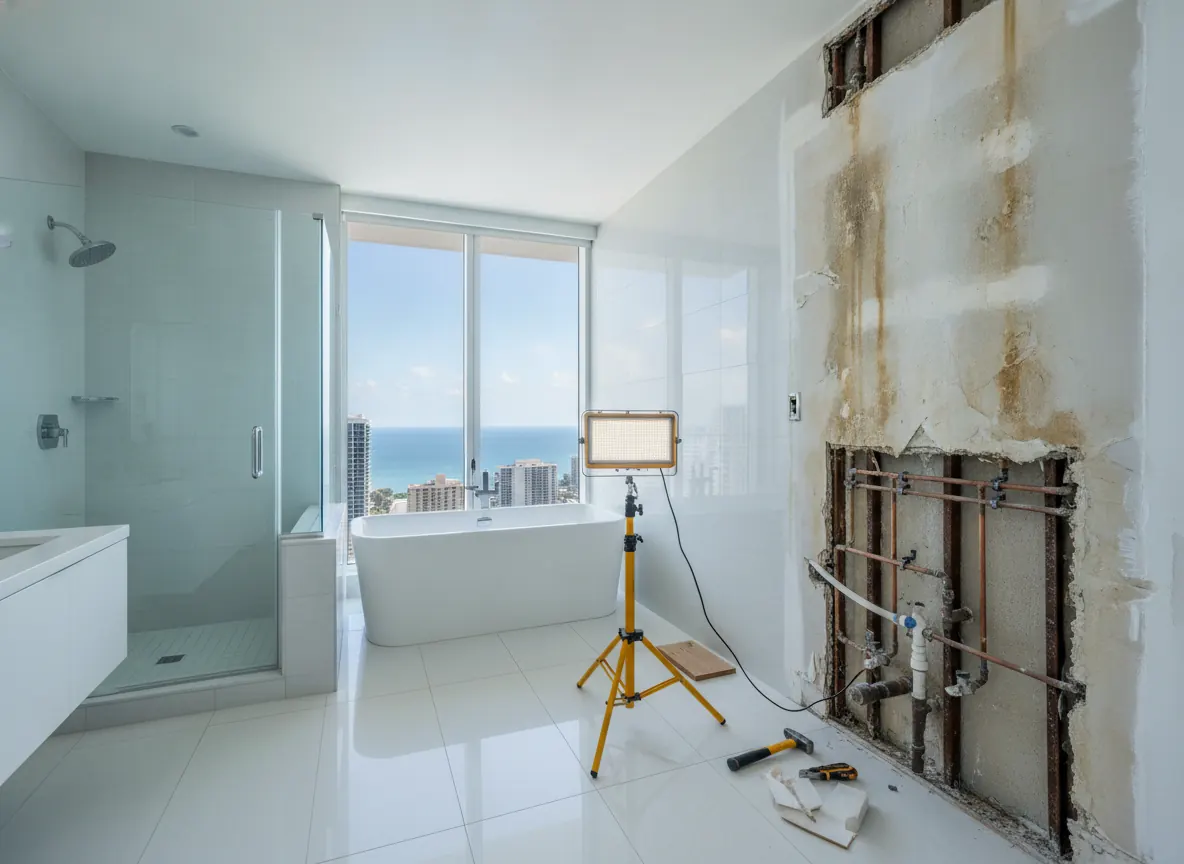
Condo living is the norm along the Naples coast. In the City of Naples, about 59.9% of all housing units are in buildings with five or more units, according to the Census Bureau's American Community Survey (2020–2024). In Pelican Bay the figure is 70.4%, and on Marco Island it is 56.4%. When you share walls, floors, ceilings, plumbing stacks and sometimes air-handling equipment with dozens of neighbors, a natural question follows: can mold in the unit next door, above or below end up in yours?
The short answer is that the bigger risk usually isn't mold "walking" through the wall. It's the water that feeds it. Mold needs moisture, and moisture moves easily between units through shared building parts. Understanding that difference tells you what to do next.
Why the water matters more than the mold
EPA's "A Brief Guide to Mold, Moisture and Your Home" puts it plainly: "If you clean up the mold, but don't fix the water problem, then, most likely, the mold problem will come back." In a condo, the water problem may not be in your unit at all. Common ways moisture crosses from one unit to another include:
- A leak from the unit above: a failed supply line, a toilet or a water heater can soak a ceiling and the wall cavities below it.
- Shared plumbing walls: a slow drip inside a wall between two bathrooms or kitchens can wet both sides of the wall without showing on either.
- Air conditioning condensate: a clogged drain line or overflowing drain pan can send water into floors and walls nearby.
- Building envelope leaks: windows, balconies, roofs and exterior walls that let in wind-driven rain can affect several units on the same stack.
- Storm surge or flooding: lower-floor units can share the same water event, as many Naples buildings did during Hurricane Ian.
Once materials like drywall, carpet pad or cabinet backs stay wet, mold can grow on your side of the wall regardless of where the water started. EPA's guidance is that "it is important to dry water-damaged areas and items within 24-48 hours to prevent mold growth." That clock starts when the water arrives, not when someone notices it.
Seasonal vacancy makes neighbor problems harder to catch
Naples has a lot of homes that sit empty for months. The American Community Survey counts about 40.8% of all housing units in the City of Naples, 41.8% in Pelican Bay and 49.2% on Marco Island as vacant "for seasonal, recreational, or occasional use." That means the unit above or beside you may be closed up all summer, when Naples gets most of its rain. A slow leak or a stalled air conditioner in an empty unit can go unnoticed for weeks while moisture spreads into shared walls and ceilings.
If you're the one leaving for the season, our guide to closing up a Florida condo for the season covers the steps that help keep humidity under control while you're away.
Signs the problem may be coming from outside your unit
- Stains, bubbling paint or soft drywall on a ceiling or a wall you share with another unit.
- A musty smell that's strongest near a shared wall, a plumbing chase or a closet against the corridor.
- Moisture or mold that comes back after you've cleaned it, with no leak you can find inside your unit.
- Problems that showed up after a neighbor's renovation, a pipe failure or a storm.
- Several neighbors on the same stack reporting similar stains or odors.
None of these prove where the water came from. Finding the source usually takes a moisture meter, sometimes a thermal camera and, often, opening a wall. A Florida-licensed mold assessor can document conditions in your unit, and a plumber or the association's contractor may be needed to trace the leak itself.
What to do if you think mold is coming from next door
Document everything
Take dated photos and video of stains, visible growth and any water. Note when you first saw it and anything you smelled or heard, such as running water in the wall.
Tell the association in writing
Email or write to your manager or board, describe what you see and ask them to investigate the source, including any neighboring unit or common element. Keep copies.
Limit the damage you control
Run your air conditioning, keep the area dry and avoid disturbing large areas of growth. EPA says homeowners can usually handle a moldy area of "less than about 10 square feet" themselves; larger areas are a job for a professional.
Call your insurer
Report the damage to your HO-6 carrier early. Coverage depends on your policy and the cause of the water, so ask the insurer directly.
Get an independent assessment
For more than about 10 square feet, Florida law requires a licensed assessor and a licensed remediator. An assessment report gives you, the association and the insurer something concrete to work from.
Who is responsible when the source is a neighbor or the building?
No Florida condo statute mentions mold by name. Responsibility generally follows the water source, the building's governing documents and how insurance is split under Chapter 718 of the Florida Statutes:
- Common elements: Florida Statutes s. 718.113(1) says "Maintenance of the common elements is the responsibility of the association," subject to limited common elements the declaration assigns to owners.
- Unit finishes: s. 718.111(11)(f) excludes items such as "floor, wall, and ceiling coverings, electrical fixtures, appliances, water heaters, water filters" from the association's coverage, and says that property and its insurance are "the responsibility of the unit owner."
- Association-insured property: s. 718.111(11)(j) says property the association insures "shall be reconstructed, repaired, or replaced as necessary by the association as a common expense." Under (j)1, a unit owner can be charged costs insurance doesn't cover when the damage results from "intentional conduct, negligence, or failure to comply with the terms of the declaration."
So the answer to "who pays?" depends on where the water came from, what your declaration says and how the insurance applies. It isn't automatically the neighbor or the association. We go deeper in Condo Mold in Collier County: Who Pays? This is general information, not legal advice; ask your association's attorney or your own attorney about your situation.
Permits and multi-unit buildings in Collier County
Condo work comes with extra rules. Collier County's post-hurricane permitting guidance says "All commercial and multi-family buildings will require a permit for any work performed." That page addresses storm repairs, but it's a good reminder to check with the county or the City of Naples Building Department, and with your association, before any rebuild work in a condo. Many associations also require contractors to provide insurance certificates and follow building rules for access, elevators and debris. Our condo and HOA mold page covers how remediation usually works in shared buildings.
Why an independent assessor helps in a condo
When more than one owner and the association are involved, a neutral written record is valuable. Florida Statutes s. 468.8419 bars a mold assessor from performing or offering remediation on a structure the assessor's company assessed within the last 12 months, and has a mirror rule for remediators. In practice, the assessor and the remediator are typically separate companies, with an exception in the statute for Division I certified contractors. An assessment typically documents where moisture readings are elevated, how large the affected area is and what a remediation scope should include, which helps everyone agree on the work.
EPA also notes that "in most cases, if visible mold growth is present, sampling is unnecessary." A good assessor will explain whether testing adds anything in your case. See mold inspection and testing for what to expect and our cost guide for typical national price ranges.
A note on health
If you or anyone in your household has symptoms you think may be related to mold, or has asthma, allergies or a weakened immune system, talk to a doctor. We can't give medical advice, and this article isn't a substitute for it.
How we can help
We are a free quote and referral service. We connect Naples and Collier County condo owners with Florida-licensed mold assessors and remediators. Tell us what you're seeing, whether it's a stain on a shared wall or a musty smell after a neighbor's leak, and we'll help you get quotes from licensed local pros. Ask any company for its Florida license number and verify it at MyFloridaLicense.com. We usually reply the same day. You can also reach us by phone: Call (727) 300-6656