
If you head north after Easter, your Naples house spends the wettest, muggiest months of the year on its own. That is normal here. The Census Bureau's American Community Survey (ACS 2024 5-year, table B25004) counts 7,707 housing units in the City of Naples, 40.8% of all units, as vacant "for seasonal, recreational, or occasional use." On Marco Island the share is 49.2%. Across Collier County, 59,512 units, about a quarter of the housing stock, fall in that category.
The months you are away are the months mold likes most. NOAA's 1991–2020 normals for Naples Municipal Airport put annual rainfall at 49.55 inches, and June through September bring 32.67 inches of it, about 66%. Our own average of NOAA hourly observations at the airport from 2015 to 2024 (a calculation we made from NOAA data, not an official normal) puts the dew point at or above 70°F in roughly 93% to 99% of hours from June through September. A closed-up house sitting in that air needs a plan before you lock the door.
Naples FL Mold Remediation is a free quote and referral service. We connect Naples and Collier County homeowners with Florida-licensed mold assessors and remediators. This checklist draws on published UF/IFAS, LCEC and EPA guidance; it does not replace advice from your AC company or a licensed pro.
Why closed-up Naples homes grow mold
The University of Florida's Extension publication Closing Your Seasonal Home (UF/IFAS HE887) puts it plainly: "the summer heat and humidity can cause mildew and mold-spore growth." LCEC, a Southwest Florida electric cooperative, says in its Vacant Homes guide that "mold and mildew can grow nearly anywhere if the relative humidity is consistently 70 percent or higher." The same guide notes that "many homeowners in Southwest Florida reside elsewhere during the summer," so this is a familiar problem in the region.
Two things go wrong in an empty house: with the AC off or barely running, nothing pulls moisture out of the air, and small leaks go unnoticed for months. EPA's mold guide says "it is important to dry water-damaged areas and items within 24-48 hours to prevent mold growth." Nobody can do that if nobody is home.
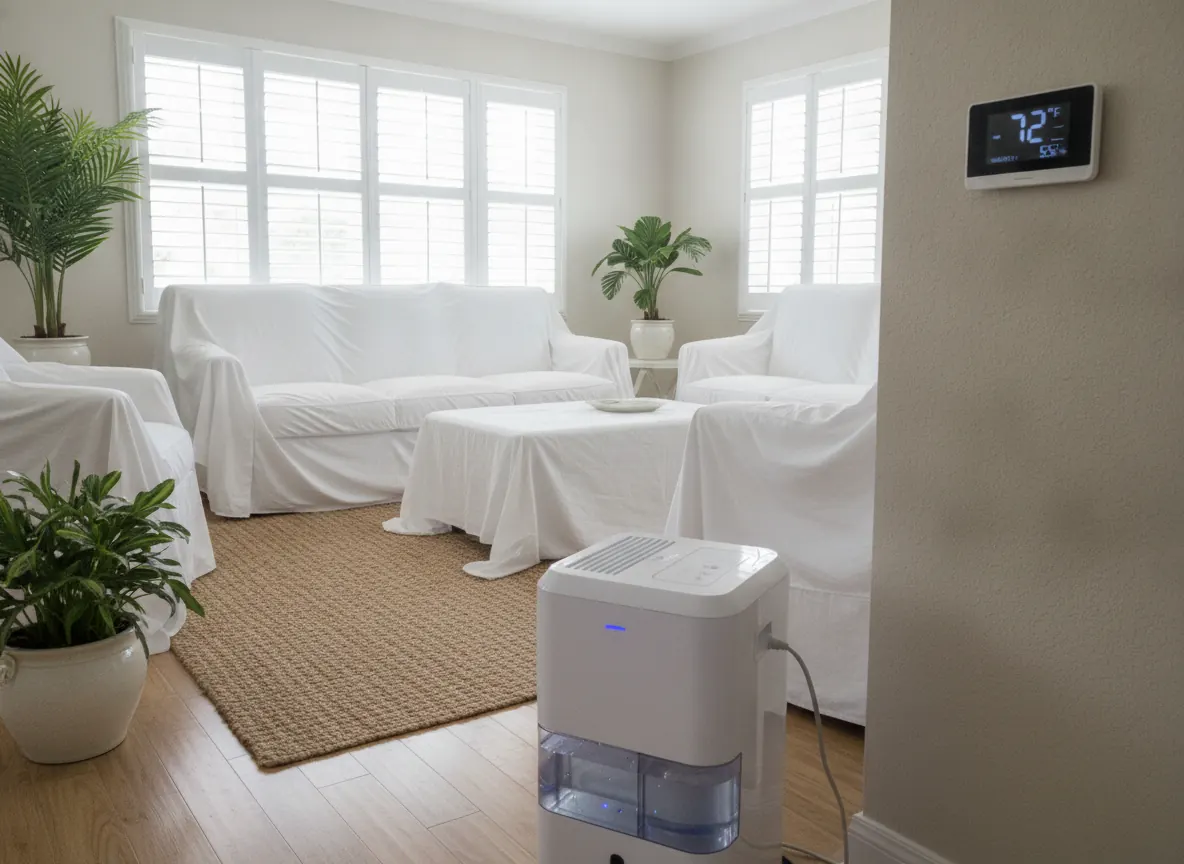
Step 1: Decide how the air conditioner will run
This is the single most important decision when closing up a Florida house for the summer. UF/IFAS HE887 says: "Leave your air conditioner set to no higher than 85 degrees (F)," and explains that "periodic air conditioner operation will remove moisture from your home." The UF/IFAS Palm Beach County Extension blog suggests a thermostat setting of 80–85°F and running central AC at least two hours a day.
LCEC's guide lays out three options and ranks them:
- A timer that cycles the AC "for two hours every day." LCEC says this gives "the highest level of security against mildew growth."
- A humidistat set "to cycle the A/C whenever indoor humidity exceeds 65 percent." LCEC says this option "uses the least power."
- A thermostat set at 83°F. LCEC calls this "the least efficient method" and recommends it "only for short or infrequent trips."
The sources use different numbers, so treat them as a published range, not one magic setting. We compare the three approaches side by side in what AC and humidity setting to use while you're away.
Whatever you choose, UF/IFAS HE887 adds: "Have the humidistat calibrated by your air conditioning company." A pre-departure service visit is also a good time to clear the condensate drain line, check the drain pan and change the filter. Our AC and HVAC mold page explains what to watch for in the air handler.
Step 2: Add moisture control beyond the AC
UF/IFAS HE887 says "a dehumidifier operated by a drain to carry away moisture can help, though not as much as air conditioning." Two details matter:
- Use a drain. A bucket-style unit fills and shuts itself off long before you come back. Run its hose to a floor drain, sink or other drain.
- Pick a unit rated for warm conditions. The UF/IFAS Palm Beach County blog suggests a dehumidifier rated to work at 70°F or higher.
Step 3: Look for leaks before you leave
EPA's mold guide warns: "If you clean up the mold, but don't fix the water problem, then, most likely, the mold problem will come back." Walk the house a week or two before you go, while there is still time to call a plumber or roofer:
- Under kitchen and bathroom sinks, and behind toilets
- Around the water heater, washing machine and refrigerator ice maker
- Ceilings under bathrooms and below the AC air handler
- Window sills and sliding-door tracks, especially on the side that takes summer storms
Many seasonal owners also shut off the main water supply when they leave; ask your plumber what makes sense for your irrigation, pool equipment and water heater.
Step 4: Line up someone to check on the house
UF/IFAS HE887 advises: "Find a trusted friend or relative to routinely check on your home." Ask that person to confirm the AC is running at your setting, sniff for a musty smell, and look for water on floors, around the air handler and on ceilings. Ask them to stop by after any big storm or power outage too. If the house took on water from a storm, the EPA's 24–48 hour drying window is the clock to beat; our hurricane and storm-surge mold page covers what happens next.
Your closing-up checklist
- AC set no higher than 85°F (UF/IFAS), or on a two-hour daily timer or 65% humidistat (LCEC)
- Humidistat calibrated by your AC company
- Condensate drain line cleared and new filter installed
- Dehumidifier with a hose to a drain, rated for 70°F or higher
- Visible leaks repaired, not just wiped up
- Plumber consulted about shutting off the main water supply
- A friend, relative or home-watch person scheduled for regular visits
Closing up a condo instead? Some steps change because the association handles common elements. See closing up a Florida condo for the season.
Coming back: what if the house smells musty?
A musty smell or new spots on walls, ceilings or cabinets are signs to take seriously. Start with the water source.
Size matters under both EPA guidance and Florida law. EPA's mold guide says that "if the moldy area is less than about 10 square feet" (roughly a 3 ft by 3 ft patch), homeowners can usually handle the job themselves. Florida Statutes s. 468.8411 defines mold assessment and mold remediation in terms of mold growth "greater than 10 square feet," and Florida requires a state license to perform or offer to perform that work. Ask any company for its Florida license number and verify it at MyFloridaLicense.com. This is general information, not legal advice.
If you want a professional opinion first, a licensed mold assessor can inspect the home. EPA notes that "in most cases, if visible mold growth is present, sampling is unnecessary," so ask what any testing would add. Under Florida's 12-month rule (s. 468.8419), the assessor and the remediator for the same home are typically separate companies, with an exception for Division I certified contractors. Our mold inspection and testing page explains how that works.
For budgeting, here are typical national ranges from cost guides, 2025–2026 (estimates, not quotes): a mold inspection runs about $450–$800, with a Florida average of about $739; remediation of a small area (about 50 sq ft) runs about $500–$1,500. Your real price comes from a licensed pro's on-site assessment. See the mold remediation cost guide for larger jobs.
Health concerns? Talk to a doctor. Found something on your return? Tell us what you're seeing and we'll help you get quotes from licensed local pros. You can also read more on our seasonal and second-home mold page.
Frequently asked questions
What temperature should I leave my Florida house at for the summer?
UF/IFAS publication HE887 says to leave the air conditioner set no higher than 85 degrees F. The UF/IFAS Palm Beach County blog suggests 80 to 85 degrees and running central AC at least two hours a day. LCEC calls an 83 degree thermostat setting the least efficient approach, meant only for short trips, and favors a daily two-hour timer or a 65% humidistat.
Is a dehumidifier enough by itself in a closed-up Naples home?
Usually not. UF/IFAS HE887 says a dehumidifier operated by a drain can help, though not as much as air conditioning. It works best alongside periodic AC operation. Choose a model with a hose to a drain so it does not fill and shut off, and one rated to run at 70 degrees F or higher, as the UF/IFAS Palm Beach County blog suggests.
What should I do if I find mold when I get back?
Fix the water source first. EPA warns that mold usually comes back if the water problem is not fixed. EPA says homeowners can usually handle areas under about 10 square feet. Florida's licensing definitions cover mold growth greater than 10 square feet, so larger areas call for a Florida-licensed pro. Verify any license at MyFloridaLicense.com. This is general information, not legal advice.